
Gentry County Projected Release Dates
“Projected release date” is a useful search phrase, but Missouri's official records use more exact labels. MODOC defines a minimum release date as the conditional-release date. Its data dictionary also identifies a Sentence-I Minimum Release Date and a Sentence Maximum Release Date. The Missouri Parole Board may assign a presumptive parole release date, which the state glossary calls tentative and dependent on continued appropriate conduct and an acceptable release plan. None of these labels means that the person has already left custody.
An actual release date records an event that occurred. It may reflect release to the community, release to supervision, transfer to a different agency, or another change in custody. The event must be paired with release type and destination. A person can leave one Gentry County custody episode and remain confined elsewhere. For that reason, a court order, minimum date, or notification should not be converted into an unsupported claim that the person reached the community.
| Date term | Missouri meaning | What it does not prove |
|---|---|---|
| Minimum release date | MODOC's conditional-release date | That release happened on that date |
| Maximum release date | Official sentence data field for the sentence maximum | That no lawful change can occur before it |
| Presumptive parole release date | Tentative Board-assigned date subject to conduct and an acceptable plan | A guaranteed parole release |
| Actual release date | Recorded custody event | Community release unless destination is also confirmed |
Gentry County Custody Changes the Date
A pretrial detainee generally has no sentence-based release date. Bond can be posted, bond terms can change, a charge can be resolved, or another court can place a hold. The Gentry County court docket shows legal events, but it does not prove the hour when the holding facility acted. Public county materials do not document Gentry County's physical detention arrangement, so the sheriff should first identify the actual holding facility.
A person serving a local sentence requires a different check. Read the Gentry County judgment, any jail-credit finding, and the release authority, then ask the holding facility for its current calculation. Gentry County publishes no county good-time policy and no weekend-release policy. Do not borrow a neighboring jail's practice or assume it controls a Gentry sentence. A named facility's record is needed because local release processing belongs to the place that actually holds the person.
A sentenced Missouri state prisoner is tracked by MODOC. State records can include sentence, county of conviction, custody status, parole or conditional-release information, and Board action. The active state search covers incarcerated people and people on active probation or parole. It expressly excludes discharged offenders, so a date lookup for a person whose state supervision is over must use the official current-and-prior file or a DOC inquiry.
Note: The court supplies legal authority, while the holding agency records when that authority produced a release or transfer.
Find Gentry County Release Dates
Begin by deciding whether the person is in local custody, state prison, or another agency's custody. A live county roster, if one existed, would address present custody, not a past release. Gentry County publishes no verified jail roster or release-date view. The safe route joins the sheriff or holding facility, Case.net, MODOC, and an event notice only when the source fits the case.
- Confirm the full name, date of birth when known, court case, and any DOC number. Similar names are not enough.
- Ask the Gentry County sheriff to identify the physical holding facility if the custody location is not clear from the record.
- Search Missouri Case.net for the judgment, sentence, bond events, jail-credit findings, warrants, and later orders.
- For a state prisoner, use the MODOC Offender Web Search and read each date exactly as labeled.
- Ask the institutional caseworker about the current calculation, overlapping sentences, conduct issues, the release plan, and known detainers.
- Use the MODOC current-and-prior data dictionary for the minimum and maximum fields when a fully discharged person is absent from the live search.
- Confirm the final release type, time, and destination with the agency that released or transferred the person.
The Gentry County released-inmate search path adds the sheriff release record and court disposition when the question is about a past event rather than a future date. For general MODOC search help, Constituent Services requests the full correctly spelled name and, when available, the DOC number and date of birth. A specific active-status question belongs with the institutional caseworker or field officer.
Gentry County MODOC Date Fields
The live MODOC search and the nightly current-and-prior file serve different needs. The live search is easier for an active offender. It can show present prison or supervision status, subject to public-record limits. The bulk file is the official archive route for current and prior offenders and carries a dictionary for coded fields. It is updated nightly, but it is not a friendly name-search interface.
The MODOC Sunshine Law page provides the current-and-prior offender download and its field documentation.
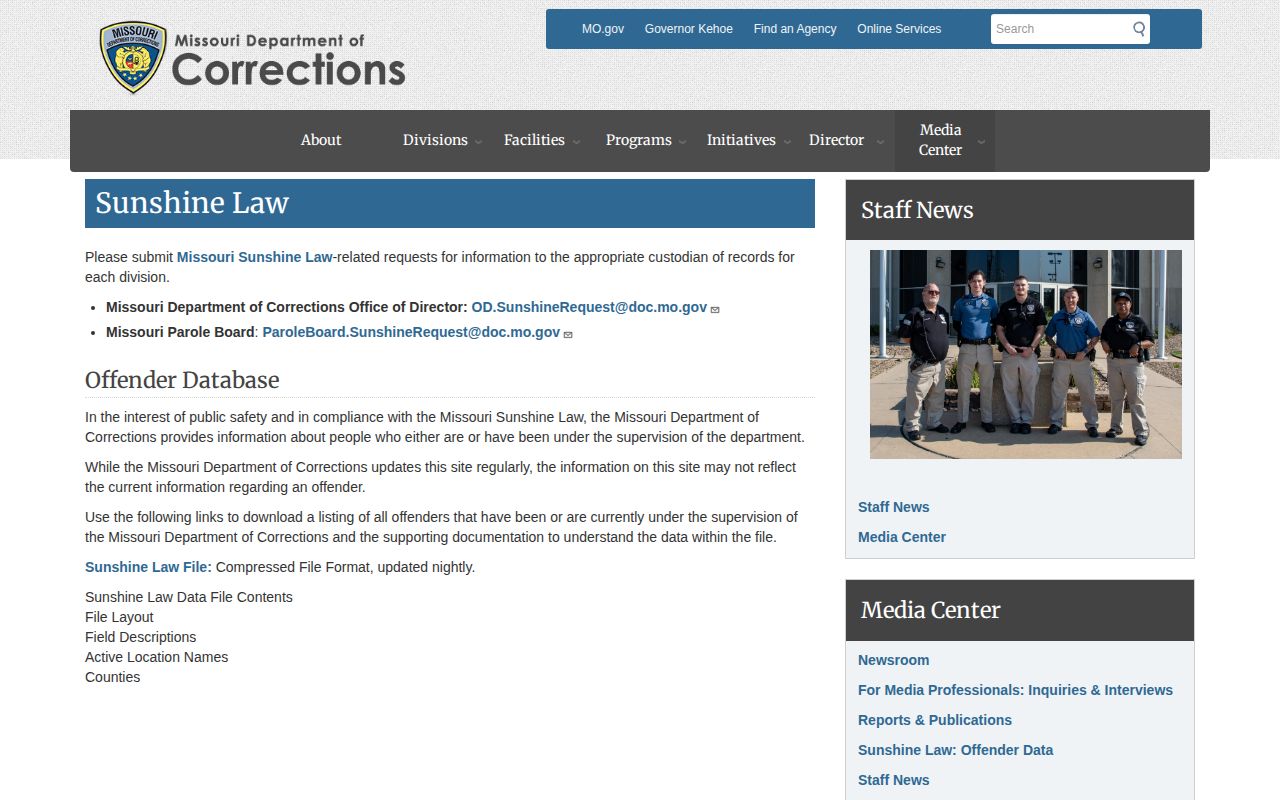
This file documents official minimum and maximum sentence fields and fills the historical gap left by the live search's discharged-offender exclusion.
The data dictionary labels $PC as “Sentence-I Minimum Release Date,” formatted YYYYMMDD and calculated on the active sentence. The companion maximum field is $PD. A code or date may still need DOC explanation when sentences overlap or an event is unclear. Raw data should not be used to announce an exact Gentry County release day without confirmation.
- Conditional release
- The supervised portion of a qualifying prison sentence after its confinement portion.
- Minimum prison term
- The statutory time before eligibility for parole, conditional release, or another early DOC release.
- Detainer
- A request or hold from another authority that can change the destination or timing of release.
- Jail credit
- Time credited by legal authority toward a sentence calculation.
Gentry County Conditional Release Rules
Missouri does not use one universal formula for every prisoner. RSMo 558.011.4 divides many terms-of-years felony sentences into prison and conditional-release portions, subject to exceptions. For qualifying terms of nine years or less, the conditional-release portion is one-third of the sentence. For more than nine through fifteen years, that portion is three years. For more than fifteen years, it is five years. The prison portion is the rest.
Those fractions do not apply without checking the current statute and offense. Dangerous felonies and specified repeat remands are excluded from the ordinary division. The law also permits extension of conditional release through a prescribed process for institutional violations. Program requirements can affect the date as well. Conditional release is part of the sentence, not informal “good time,” and the person remains under supervision after leaving prison.
A Gentry County court judgment supplies the term and offense, but MODOC performs the state sentence calculation. The court record, DOC fields, and caseworker's current explanation should agree before a date is treated as reliable. If they do not, collect the labels and dates from each source and ask the record owner to resolve the difference.
Gentry County 85 Percent Rule
Missouri's 85 percent rule is limited. It is not a rule that all Missouri prisoners must serve 85 percent of every sentence. Under RSMo 558.019, subsection 3 sets an 85 percent minimum prison term for a dangerous felony, with the statute's age-seventy alternative. The offense classification and current statutory text must be checked.
The same section uses other minimums for listed non-dangerous-felony situations involving prior DOC prison commitments. The cited framework uses 40 percent for one prior commitment, 50 percent for two, and 80 percent for three or more, subject to statutory alternatives and exclusions. A minimum prison term controls eligibility for parole, conditional release, or another early DOC release. Eligibility does not compel the Board to grant release that day.
For these calculations, the statute treats life as thirty years and an aggregate term over seventy-five years as seventy-five. Those special definitions show why sentence length alone is not enough. The offense, prior commitments, consecutive or concurrent structure, and Board action all matter. A simple percentage calculator cannot safely produce a Gentry County projected release date.
Gentry County Post-Release Credits
Earned Compliance Credits address time under community supervision, not a broad prison good-time deduction. RSMo 217.703 applies to qualifying people on probation, parole, or conditional release. When its requirements are met, credits may support final discharge before the scheduled supervision expiration. MODOC recalculates qualifying supervision terms and gives notice under the statute.
This distinction prevents a common date error. Earned Compliance Credits should not be subtracted from a current prisoner's sentence to predict when the prison door will open. They act after release for a qualifying person under supervision. Prison release calculations instead depend on the sentence, conditional-release law, minimum terms, Board action, conduct, program requirements, and any holds.
A person can therefore have an actual prison release date, a later scheduled end of supervision, and an earlier final supervision discharge due to lawful credits. Each date answers a different question. Use the DOC record or court order that names the event rather than calling all three a “release date.”
Note: Prison release ends confinement, while supervision discharge ends the remaining probation, parole, or conditional-release term.
Why Gentry County Release Dates Change
A release calculation is a current agency assessment, not a promise. The source may change after a new order, corrected credit, or Board action. Institutional conduct can affect conditional release or a presumptive parole plan. Another authority can place a warrant or detainer. Multiple sentences can also require a new interpretation of whether time runs at the same time or one term follows another.
| Changing factor | Possible effect | Best confirmation source |
|---|---|---|
| Amended judgment | Changes the controlling sentence or release authority | Gentry County court and MODOC |
| Corrected jail credit | Moves the calculated sentence dates | Court finding and holding agency |
| Consecutive or concurrent interpretation | Changes how more than one term is combined | Court judgment and MODOC caseworker |
| Board grant, denial, or later action | Sets, delays, alters, or rescinds a parole plan | Missouri Parole Board notice |
| Institutional conduct or program issue | May extend conditional release or defeat a tentative plan | MODOC caseworker and official record |
| Warrant or detainer | Can prevent community release or send the person to another authority | Holding agency and issuing authority |
| Release-plan problem | Can affect a presumptive parole date | Board notice and MODOC |
Transfers deserve special care. A person may be released from one facility to MODOC, another county, federal custody, or another authority. The first agency can record a release even though the person stays confined. Ask for release type and destination, not merely “released: yes or no.”
Confirm Gentry County Actual Release
MOVANS can provide notice of a custody change for participating Missouri sources. It is useful as an alert, not a certified release record. The system changed in May 2026, and current local-jail registrations use SMS and email rather than legacy telephone and app delivery. An unsuccessful local search may mean a jail is offline, and all reported events can lag.
Register against the correct person and agency record, then preserve the confirmation. When an alert arrives, call the releasing facility to ask what event occurred, its date and time, and the destination. If the person is a MODOC prisoner, compare the alert with the DOC record and institutional caseworker's calculation. Current notification steps are covered in the Gentry County VINE inmate check.
Final proof comes from the record owner. For a local episode, that is the actual holding facility and the Gentry County court authority. For a state term, it is MODOC and, when parole is involved, the Board notice. The minimum, maximum, presumptive, and actual dates can all be valid at once because each describes a different stage.